What If the Moon Were Half as Far? We Calculated Its Size and Orbit | What If, Calculated #07
Short answer
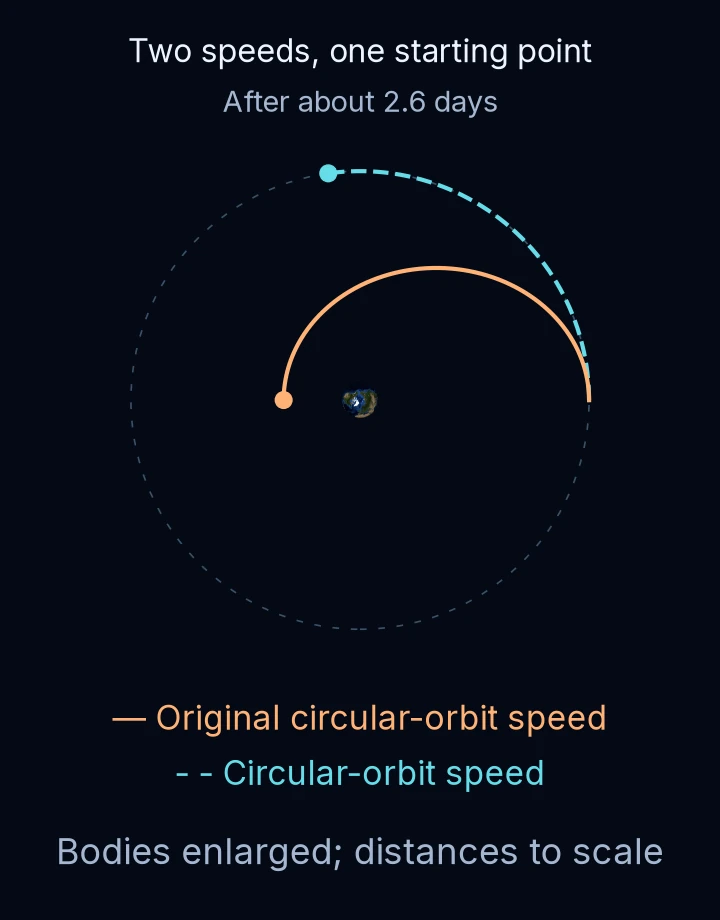
- At half distance with its original circular-orbit speed, the Moon first approaches to about 64,000 km after about 2.6 days.
- Adjusting the speed for a circle gives an orbital period of about 9.6 days.
- At half distance, apparent diameter is about 2.0 times baseline, while near-side differential pull is about 8.2 times baseline.
Also calledMoon half as far awaycloser Moon orbitMoon distance and speed
Video

Pressing play loads the YouTube player on this page. Watch on YouTube
Try it
Explained
In the video
What if the Moon were half as far away?
A larger Moon in the sky is easy to picture. Its next move is less obvious. Would it keep circling Earth at its new distance, or move farther inward?
Distance alone does not settle the question. The starting speed matters too. We built an isolated Earth–Moon model and released the Moon from the same position with two different sideways speeds. This is Tamelabo’s hypothetical calculation, not a prediction of a real event or a proposal for moving the Moon.
Our baseline is the published mean separation of 384,400 km, measured from Earth’s center to the Moon’s center. Half that distance is 192,200 km. We are not halving the Moon’s observed distance on a particular night.
The result, with the starting conditions attached
Both experiments begin at the same half-distance position. The Moon retains its physical size and mass.
| Starting-speed rule | Calculated outcome |
|---|---|
| Circular-orbit speed: 1.45 km/s | A circle at the new distance, taking about 9.6 days per orbit |
| Original circular-orbit speed: 1.02 km/s | An inward swing, with the first closest approach after about 2.6 days |
In the second experiment, the closest center-to-center separation is about 64,000 km: about five Earth diameters. That is a comparison of lengths between the centers, not five Earths fitting into the gap between the surfaces. The Moon then swings around Earth and moves away again. It does not hit the surface in this experiment.
At the initial half-distance position, the apparent lunar diameter is about 2.0 times baseline. The difference between the Moon’s pull on Earth’s near-side surface and its pull on Earth’s center is about 8.2 times baseline. The latter is a difference in acceleration, not a prediction of sea height.
What changes, and what stays fixed?
We instantaneously reset the relative position, then start the clock. We do not calculate the inward journey, the energy required to move the Moon, or an impulse delivered to the oceans. Energy and angular momentum are not assumed to be conserved during the position reset.
At release, the relative velocity is perpendicular to the Earth–Moon line. Its initial inward component is zero. After release, there is no external support or continuing push.
| Input | Adopted value |
|---|---|
| Baseline separation D | 384,400 km |
| Earth GM | 398,600.435507 km³/s² |
| Moon GM | 4,902.800118 km³/s² |
| Earth mean radius R | 6,371.0084 km |
| Moon mean radius Rm | 1,737.4 km |
| One day | 86,400 seconds |
GM is mass multiplied by the gravitational constant. We call the sum of the two gravitational parameters μ. The real lunar orbit is not a perfect circle. A circular baseline is a deliberate simplification that lets us separate the effects of distance and starting speed.
How large would the Moon look?
Imagine standing on Earth directly beneath the Moon and looking straight up. The distance from the observer to the Moon’s center is the center-to-center separation r minus Earth’s radius R. The angular diameter is
θ = 2 asin(Rm/(r−R)).
Here, asin converts a ratio into an angle. The baseline angular diameter is 0.527°, and the half-distance value is 1.071°. Dividing the unrounded values gives a diameter ratio of about 2.0. We do not calculate that ratio again from the rounded angles.
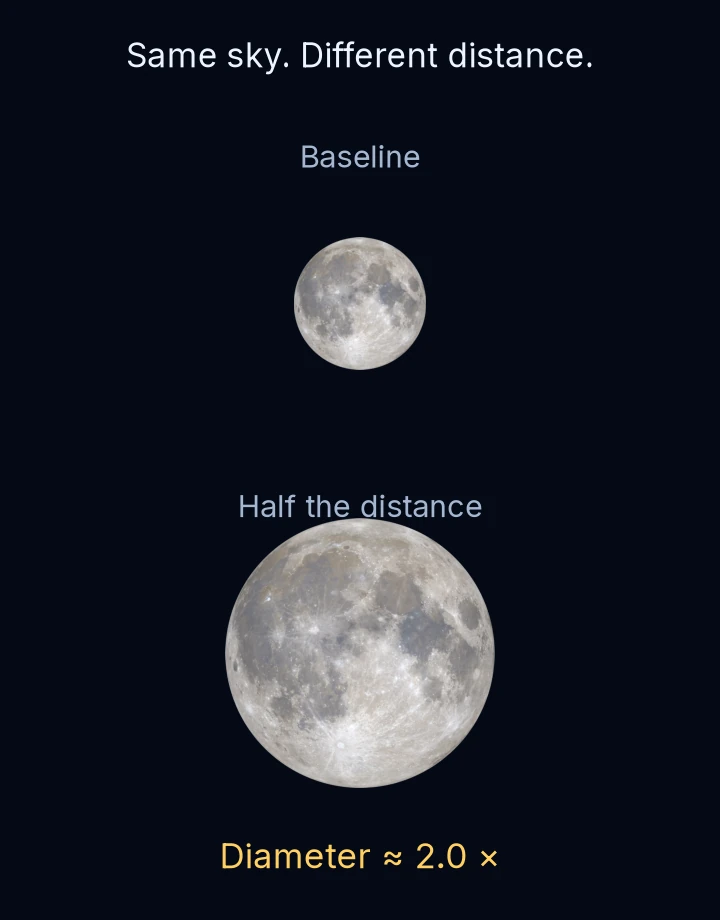
The physical Moon has not expanded; the viewing distance has shortened. A diameter ratio is different from an area ratio. Both images use a full disk and a fixed surface orientation for comparison. We do not calculate subsequent phases or the Moon’s rotation.
The interactive sky view also represents an observer directly beneath the Moon at each instant. It is not a continuous view from one town as Earth rotates.
Why the same position produces two paths
An orbit combines sideways motion with inward acceleration. Earth’s pull continually bends the Moon’s path. With the right sideways speed, the path bends just enough to remain at a constant separation.
Let r be the relative position vector from Earth to the Moon. We integrate
d²r/dt² = −μ r / |r|³.
Although the drawing keeps Earth at the center, the equation includes the Moon’s contribution to the relative motion. Earth has not been treated as an infinitely massive, immovable object.
Adjusting the speed to preserve a circle
The circular-orbit speed is v = √(μ/r). It is 1.02 km/s at the baseline distance, but 1.45 km/s at half that distance. This experiment changes both the position and the initial speed.
The orbital period is T = 2π√(r³/μ). The baseline model gives about 27.3 days. The half-distance circular orbit takes about 9.6 days. These are times to orbit Earth in the model, not the cycle of lunar phases.
Keeping the original circular-orbit speed
At the closer position, 1.02 km/s is insufficient to maintain a circle. The Moon moves inward, speeds up as it approaches Earth, and swings around it.
We can check the numerical result independently using orbital energy and angular momentum. Specific orbital energy ε and the magnitude of specific angular momentum h are
ε = |v|²/2 − μ/|r|, and h = |r×v|.
The semimajor axis a, half the longest diameter of the ellipse, and the eccentricity e, a measure of how elongated it is, follow from
a = −μ/(2ε), and e = √(1 + 2εh²/μ²).
For our original-speed experiment, a = D/3 and e = 0.5. The smallest separation is therefore a(1−e) = D/6, or about 64,000 km.
The Moon starts at the farthest point of this ellipse. One orbit takes about 5.3 days, so the first closest approach comes half an orbit later, after about 2.6 days. In the animation, both Moons always use the same clock. When time slows near closest approach, it slows by the same factor for both paths.
Checking the calculation
We use fourth-order Runge–Kutta integration with 60-second steps. States are recorded every 600 seconds for drawing. Closest approach is found within a step, so the result card does not merely use the smallest distance that happened to fall on a saved drawing sample.
We checked against a half-sized time step, an independent DOP853 solver, and the analytic ellipse equations. Position differences in the three main cases were below 0.001 km. All 22 conditions offered in the interactive experiment were checked as well. A production rerun reproduced the planning data exactly.
That verifies the numerical implementation. It does not remove the uncertainty introduced by simplifying the real physical system.
The difference in pull that helps drive tides
For this comparison, we reset the Moon to the half-distance starting position. We are no longer using the distance at closest approach.
A place closer to the Moon experiences a stronger lunar pull. Earth’s center is accelerated too, but the near-side surface is accelerated a little more. Subtract the shared component, and the remaining near-side difference is
Δg_near(r) = GM_moon × [1/(r−R)² − 1/r²].
At half the baseline separation, this difference is about 8.2 times its baseline value. Such differences across Earth help drive tides.
Why about 8.2 rather than exactly 8?
If Earth’s radius is treated as very small compared with the separation, the leading approximation is Δg ≈ 2GM_moon R/r³. Under that approximation, halving the distance gives a factor of eight.
Our calculation retains Earth’s finite radius and subtracts the two accelerations directly. That produces about 8.2, rather than exactly eight. The difference is not a rounding error. The far-side differential acceleration need not have the same ratio as the near-side value either.
A different quantity: four times the pull at the center
The Moon’s acceleration of Earth’s center is GM_moon/r². Halving the separation makes it 4.0 times as large. That compares the pull at the center, whereas the 8.2 ratio compares the difference between surface and center.
Neither quantity, by itself, predicts tide height. Ocean depth, coastlines, water inertia, friction, and other conditions also shape actual water levels. We have not simulated those processes, so we cannot infer a rise in meters or a flooding map from this experiment.
Reading the result correctly
“Closer Moon” describes a position, not a complete initial condition. Once the starting velocity is specified too, the different paths become understandable and testable.
Keep track of what each distance measures. The approximately 64,000 km closest approach is center to center, not altitude above Earth’s surface. In the orbital drawings, bodies are enlarged for visibility while the separation uses the stated distance scale. Apparent visual drama is not a substitute for that scale.
Where this differs from reality
The model leaves out the Sun, other bodies, orbital inclination, Earth’s flattening, ocean motion, deformation of either body, and long-term tidal evolution. It does not predict earthquakes, lunar breakup, eclipse dates, or whether the long-term environment would be safe.
What it does provide is the subsequent motion under explicitly chosen conditions, plus geometric and acceleration comparisons at the calculated separations.
Common questions
Would the Moon fall into Earth?
In our original-speed experiment it moves inward, reaches closest approach, and then moves away. It does not reach Earth’s surface. This does not imply that every possible starting velocity would avoid a collision.
Would tides be 8.2 times higher?
That is not what the number measures. It is the ratio of near-side differential lunar acceleration. An ocean simulation would be needed to calculate water levels.
Does half the distance always mean a 9.6-day orbit?
Only for the adjusted circular-orbit speed in this experiment. Keeping the original circular-orbit speed produces an ellipse with a different orbital period.
Did you calculate how to bring the Moon closer?
No. The position reset is an assumed starting operation. Its mechanism, energy cost, and effects during transport are outside the model.
Try a different starting condition
Open the Moon experiment. It starts paused at half distance with Original circular-orbit speed selected. Play it, watch the inward swing, then reset and select Circular-orbit speed at the same distance.
Next, try three quarters of the baseline distance. Predict how far inward the Moon will move before pressing play. At the full baseline distance, the two speed rules become identical.
The distance range is 0.50–1.00 times baseline in steps of 0.05, giving 22 combinations with the two speed rules. The experiment is silent by default. Equations and detailed values are available in an expandable section; you can explore without reading them first. Saved result images include the starting conditions, and a shareable link preserves distance, speed rule, and language.
Sources
Where the facts and numbers in the video and on this page come from.
- NASA Moon Facts (adopted mean separation of 384,400 km. See also)science.nasa.gov/moon/facts
- How Far Away Is the Moon?spaceplace.nasa.gov/moon-distance/en
- NASA CGI Moon Kit (the 2019 LROC WAC global map. NASA’s Scientific Visualization Studio; data: LRO LROC WAC / ASU; visualization: Ernie Wright)svs.gsfc.nasa.gov/4720
- Blue Marble: Next Generation, Base Map (July 2004 monthly composite. Earth image: NASA Earth Observatory)science.nasa.gov/earth/earth-observatory/blue-marble-nex…
- Series explanationscience.nasa.gov/earth/earth-observatory/blue-marble-nex…
- JPL Astrodynamic Parameters (Earth and Moon GM from DE440, and seconds per day)ssd.jpl.nasa.gov/astro_par.html
- JPL Planetary Physical Parameters (Earth’s mean radius)ssd.jpl.nasa.gov/planets/phys_par.html
- Planetary Satellite Physical Parameters (the Moon’s mean radius)ssd.jpl.nasa.gov/sats/phys_par
- JPL Fundamentals of Orbital Mechanics (, and)spsweb.fltops.jpl.nasa.gov/portaldataops/mpg/MPG_Docs/MPG%20Book/R…
- NASA How Orbital Motion is Calculated (orbital energy, ellipses, and periods)pwg.gsfc.nasa.gov/stargaze/Smotion.htm
- NOAA What Causes Tides? (, and)oceanservice.noaa.gov/education/tutorial_tides/tides02_cause.…
- NOAA Tides (differential gravitational effects and the conditions shaping actual tides)noaa.gov/education/resource-collections/ocean-co…
Voice, music, art
- Voice: Irodori-TTS (Japanese) / Kokoro (English), using the selected series voices.
- Music (OpenTracks): “楽しく軽快に” by yuki; “考え中” by 鷹尾まさき; “突破口の手がかり的なBGM” by 鷹尾まさき; “Shall we meet?” by MATSU.
- Fonts: Zen Maru Gothic / Inter / M PLUS Rounded 1c (SIL Open Font License).