I Am a Cat by Natsume Sōseki: Is the Cat Really Wiser Than Humans? | Classics in 5 Minutes #14
The story in brief
- A nameless cat lives with a schoolteacher and observes the humans around him.
- His grand theories cannot remove the mochi stuck to his teeth, and he hides the mishap from Mikeko.
- His own vanity joins the human comedy, before leftover beer leads him to the water jar and the end of his voice.
Also calledI Am a Cat plot summaryI Am a Cat endingNatsume Soseki cat narrator
Video

Pressing play loads the YouTube player on this page. Watch on YouTube
Explained
In the video
This guide includes the ending. Natsume Sōseki, a major Japanese novelist, gives the narrative voice to a nameless cat who moves into a schoolteacher’s home. From floor level, the cat surveys a world of impressive opinions and very ordinary weaknesses. The joke gradually includes the observer himself.
The setting is early twentieth-century Japan. The illustrations show tatami, woven floor mats, and shoji, paper sliding screens. The house, its visitors, and their conversations remain Japanese; a few brief explanations below will help if this world is unfamiliar. This guide follows the eleven chapters of the complete Japanese text available at Aozora Bunko.
The plot in thirty seconds
An abandoned cat finds shelter in the home of Kushami, a schoolteacher. He mocks the teacher’s naps, his friends’ pretensions, and the gap between fine words and actual behavior. Yet the cat gets mochi stuck to his teeth, turns his struggle into a series of grand discoveries, and conceals the embarrassing mishap from his companion Mikeko. Around him, marriage discussions, a burglary, a quarrel with schoolboys, and long conversations accumulate. Near the end, the visitors drink beer to celebrate Sanpei’s prospective marriage. The cat drinks the leftovers, becomes drunk, falls into a water jar, struggles unsuccessfully to escape, and speaks of his death.
What kind of novel is this?
This is not a detective story in which a clever cat solves one central case. Its shape comes from observation, conversation, and recurring social absurdities. The proposed marriage provides one thread, but it does not explain every chapter.
Knowing the events does not exhaust the pleasure. Much of the comedy lies in the narrator’s elaborate explanations for small things. His self-reference, wagahai, has a grand, self-important flavor in Japanese. The English pronoun “I” does not carry that flavor by itself, and Wagahai is not his proper name.
Characters and their connections
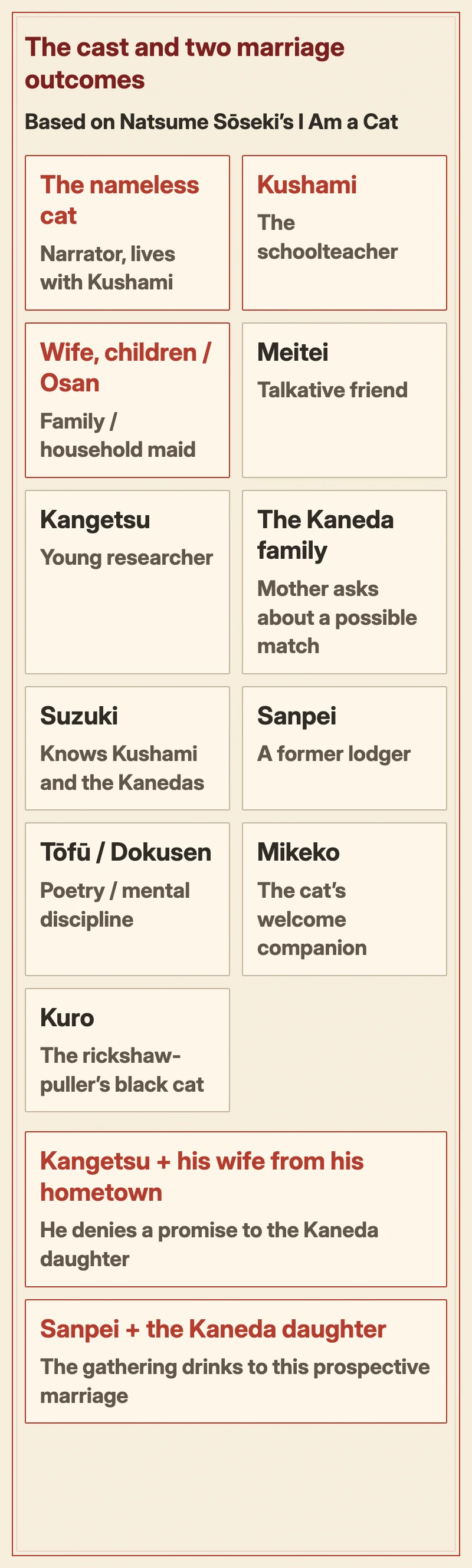
- The nameless cat narrates the novel. He lives with Kushami and confidently judges both people and other cats. His coat is described as yellowish pale gray with black patches; he is not the solid-black cat Kuro.
- Kushami, the schoolteacher, owns the house. His name sounds like the Japanese word for “sneeze.” That resemblance does not establish a scene in which he receives a nickname. The cat often sees him asleep before a book and remarks on his digestive troubles.
- The teacher’s wife and children belong to the domestic world that the visitors’ learned conversation can overlook. His wife offers another view of his habits.
- Osan, the household maid, initially puts the cat out. Later she removes the sticky mochi from his teeth on the teacher’s orders. She and the teacher’s wife are different people.
- Meitei, Kushami’s talkative friend, tells plausible stories with great assurance. His advice about drawing becomes a joke at the teacher’s expense.
- Kangetsu, a young researcher, visits the house. He is discussed as a possible husband for the Kaneda daughter, but eventually returns with a wife from his hometown.
- Mrs. Kaneda and her family are wealthy. She asks about Kangetsu as a possible husband for her daughter and takes an interest in whether he will obtain an academic doctorate. The doctorate is not a qualification to practice medicine.
- Suzuki, an old acquaintance of Kushami, also speaks with the Kanedas. His language shifts to suit his audience, and he is involved in both the marriage discussions and the school dispute.
- Sanpei, a young man who formerly lived with the teacher, says he has decided to marry the Kaneda daughter. He brings beer for an advance celebration. He is not Kangetsu.
- Tōfū takes part in literary conversation and presents a poetry collection in Chapter Six.
- Dokusen is associated with talk about mental discipline and self-cultivation: attempts to improve one’s habits and state of mind.
- Mikeko is a calico cat with a red collar and a bell. The narrator likes to visit and talk to her when he needs cheering up. He learns of her death in Chapter Two.
- Kuro, the rickshaw-puller’s cat, is a large solid-black cat. A rickshaw is a small passenger carriage pulled by a person; this is not the cat of a modern car dealership.
Keep the two outcomes separate: Kangetsu and his wife from his hometown, and Sanpei and the Kaneda daughter. Otherwise the beer celebration near the end becomes easy to misunderstand.
The eleven chapters
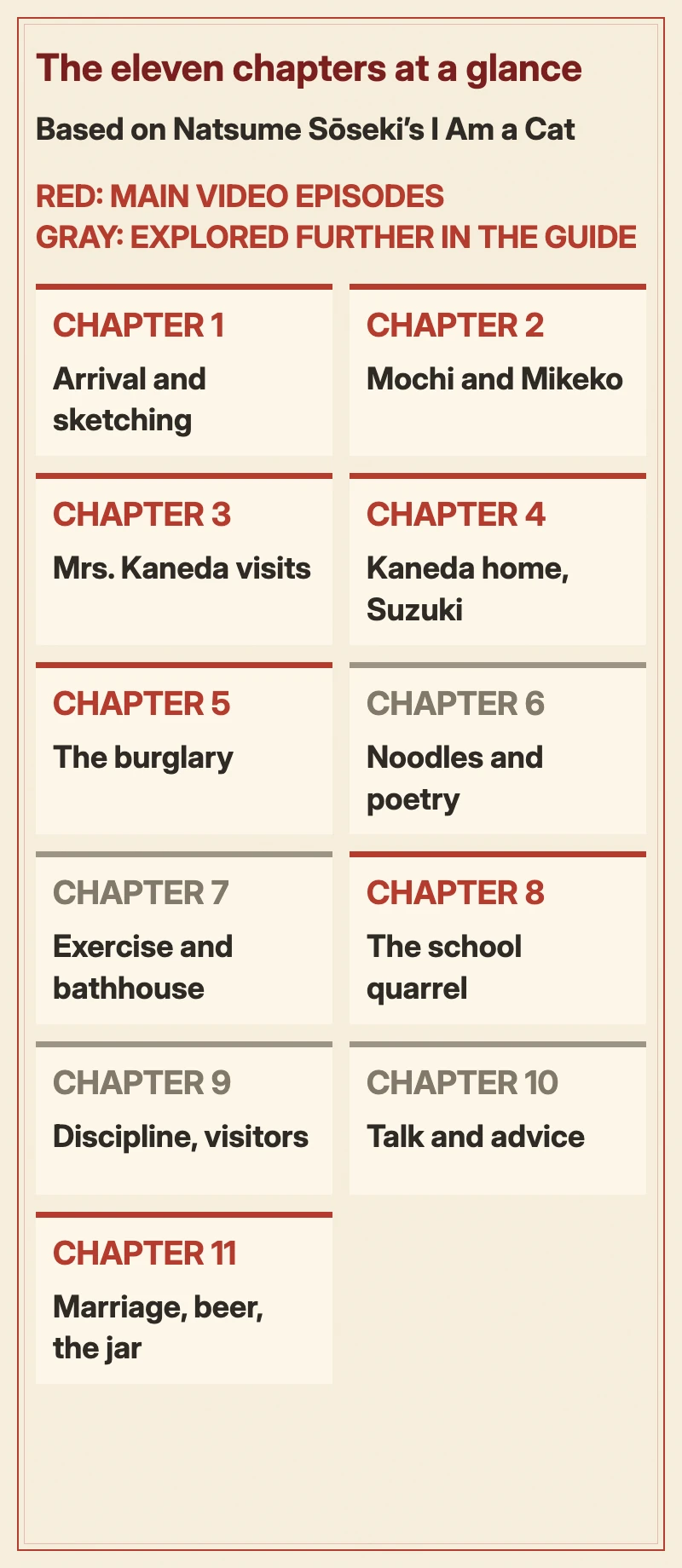
These are the novel’s chapter numbers, not the video’s scene numbers. The red chapters provide the main video episodes. The other chapters expand the household and its world rather than serving as disposable gaps.
Chapter One: A cat finds a home
The cat cannot clearly account for his birthplace. After being abandoned, he grows hungry and enters a property through a broken bamboo fence. Osan repeatedly puts him out, but the teacher says he may stay. The teacher does not go out and deliberately rescue him.
The cat watches household life from below. Seeing the teacher nap over his books, he concludes that teaching is easy. That is the cat’s limited judgment, rather than an established account of the profession.
Meitei then presents advice about sketching as the teaching of an Italian painter. Kushami believes him and draws the cat. Only later does Meitei reveal that he invented the story. The sequence matters: impressive advice, earnest effort, then the exposure of the invention. It should not be presented as an authentic quotation from art history. Encounters with Kuro also show that the narrator judges other cats as readily as humans.
Chapter Two: Mochi, grand truths, and Mikeko
At New Year, the cat finds leftover mochi, a sticky rice cake. It sticks to his teeth. Trying to pull it off, he ends up on his hind legs while the household laughs. Throughout the struggle, he announces a succession of “truths.” The teacher finally orders someone to help, and Osan removes the mochi.
The narrator then visits Mikeko. When she worries about his appearance, he says thinking has given him a headache. He does not tell her about the rice cake. Read directly after the kitchen scene, that explanation invites us to notice the narrator’s own vanity.
The chapter also includes conversation involving Kangetsu and Meitei. Later, the cat learns that Mikeko has died. The accusations of others do not establish that the narrator killed her. His loss should be understood after his relationship with her, rather than reduced to another quick comic reversal.
Chapter Three: A proposed marriage and a doctorate
After losing Mikeko, the cat describes his loneliness and a feeling of drawing nearer to human society. The teacher’s writing, household finances, and Kangetsu’s research contribute to the conversations.
Mrs. Kaneda visits to ask about Kangetsu as a possible husband for her daughter. This is a proposed marriage discussed through acquaintances, not an existing engagement between the young people. Her interest in a doctorate moves the conversation from scholarship toward social standing. It does not establish a simple, agreed rule that earning the degree will guarantee the marriage.
Chapter Four: Listening at the Kaneda home
The cat enters the Kaneda property and overhears conversation involving the couple and Suzuki. His role is to observe, not to thwart a plot and save the people around him.
Speaking to Kushami, Suzuki denies that the family is arrogantly declaring it will give the daughter only if Kangetsu becomes a doctor. Yet he still suggests that the degree would help the family’s standing and urges progress toward it. Keep his explanation separate from Mrs. Kaneda’s earlier questions. Together they reveal how people can disavow an unattractive demand while continuing to care about appearances.
Chapter Five: A burglary and household possessions
A burglar enters the house at night. The cat tries to wake his master and fails. Afterward, the teacher and his wife talk about what has been stolen.
The novel’s disturbances extend beyond marriage negotiations. Even ordinary possessions and domestic disagreements become material for the narrator’s large explanations. Sanpei also appears, introducing a person who will matter to the later marriage announcement.
Chapter Six: Explanations for noodles and poetry
The cat’s reflections on humans continue through a hot day. In the sitting room, Meitei discusses how to eat soba, thin buckwheat noodles, and Tōfū shows a poetry collection. Kangetsu and the others join the conversation.
Food, scholarship, and art all become occasions for authoritative explanations. The point is not to extract a dependable etiquette manual or a definitive theory of literature. Watch the people who enjoy explaining and the way their conversation grows.
Chapter Seven: The observer is observed
The cat discusses his exercise and visits a sentō, a public bathhouse, to inspect human behavior. Back at home, the teacher and his wife talk about the cat’s sounds and language.
A narrator who treats people as objects of study becomes an object of study himself. His remarks about humans remain remarks made by a character, not facts that this guide endorses as general knowledge.
Chapter Eight: The teacher and the schoolboys
Kushami quarrels with students from the nearby private middle school, Rakunkan. Interference from Kaneda and Suzuki forms part of the disturbance. It cannot all be explained away as an accidental ball game.
Different people offer the teacher different advice about how to handle life and conflict. Separating the immediate quarrel from their competing recommendations makes the long conversations easier to follow.
Chapter Nine: Self-cultivation meets visitors
The teacher attempts mental self-cultivation, but ordinary social life keeps interrupting. Meitei’s uncle visits, Dokusen becomes a topic of conversation, and news arrives that stolen property has been found.
Elevated ideas sit beside the practical business of receiving people and responding to them. The chapter continues the novel’s interest in how far a fine explanation will actually take someone through daily life.
Chapter Ten: Other views of the teacher
The teacher’s wife talks with Yukie. Insurance, the recovery of stolen property, and a student’s troublesome love-letter affair also enter the narrative. The student Buemon seeks advice about an affair involving the lending of his name.
These episodes offer views beyond those of the learned men in the sitting room. They should not all be forced into one marriage plot. Their speakers, circumstances, and shifting perspectives are part of the novel’s shape.
Chapter Eleven: Two marriage outcomes, then the cat’s ending
The visitors continue talking and playing go, a board game. Kangetsu has returned with a wife from his hometown and denies a promise to marry the Kaneda daughter. Sanpei then says he has decided to marry that daughter himself. He supplies beer for an advance celebration of his good fortune. The wedding and formal reception are still ahead.
The cat reflects that sadness lies beneath the apparent ease of these people. This is his observation. His later prediction about the teacher dying of a stomach illness is not a narrated scene of the teacher’s actual death. Finally, the story turns back to the cat’s own actions.
The ending: what happens to the cat?
The following section describes the death and closing words in detail.
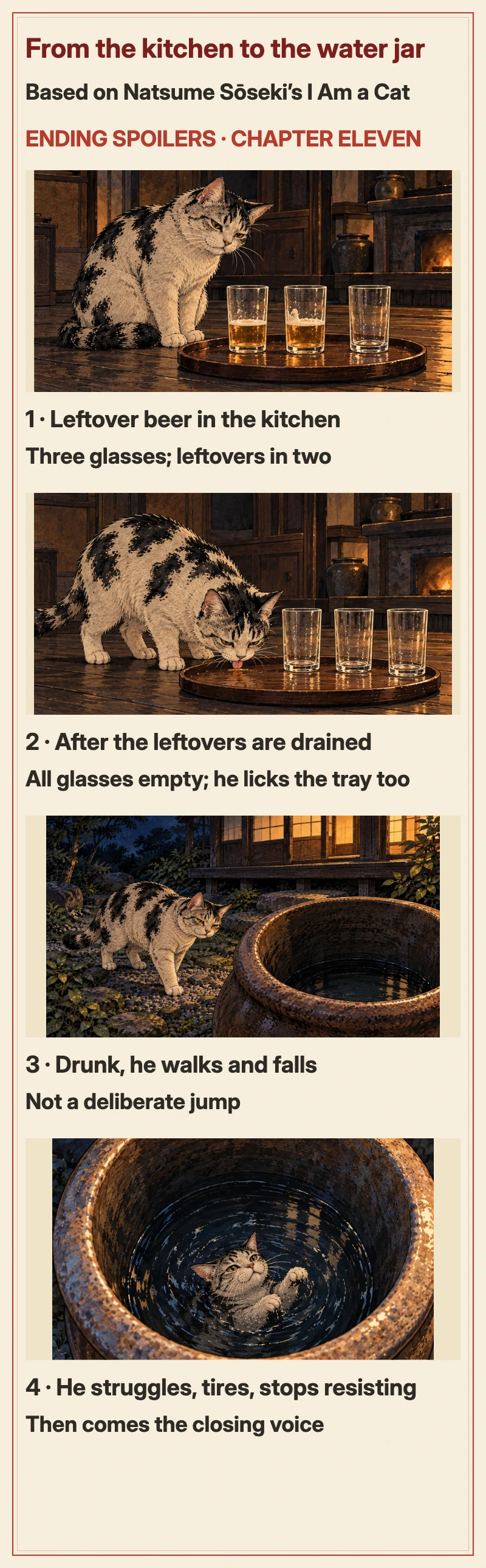
In the kitchen, the cat finds three glasses on a tray. Two contain leftover beer. He drains those leftovers and licks up beer spilled on the tray. At this point all the glasses are empty; the tray is not later carried into the garden.
He goes outside drunk and falls into a large earthenware water jar. It is not a well, barrel, or pond. Trying to climb out, he slips and cannot reach the rim. He struggles repeatedly, tires, and eventually stops resisting.
I die. Our translation; Chapter Eleven, excerpt from the closing paragraph.
This is not the novel’s final sentence. The narration continues with death and taihei, a state of peace or tranquillity. The cat repeats Namu Amida Butsu, a Buddhist phrase calling on Amida Buddha, and ends with repeated words of gratitude. A brief meaning of the phrase is “I take refuge in Amida Buddha.” It is not a phrase used exclusively at the moment of death.
The sequence does not describe a deliberate leap into the jar. The cat falls and tries to escape. That is the basis for answering the question of suicide. How we hear his later voice is a separate interpretive question. Enlightenment, resignation, and irony are possible responses to consider; this guide does not assign the cat a religious denomination or declare that he has been saved. Nor does it turn the ending into advice to seek death.
Why the narrator’s own vanity matters
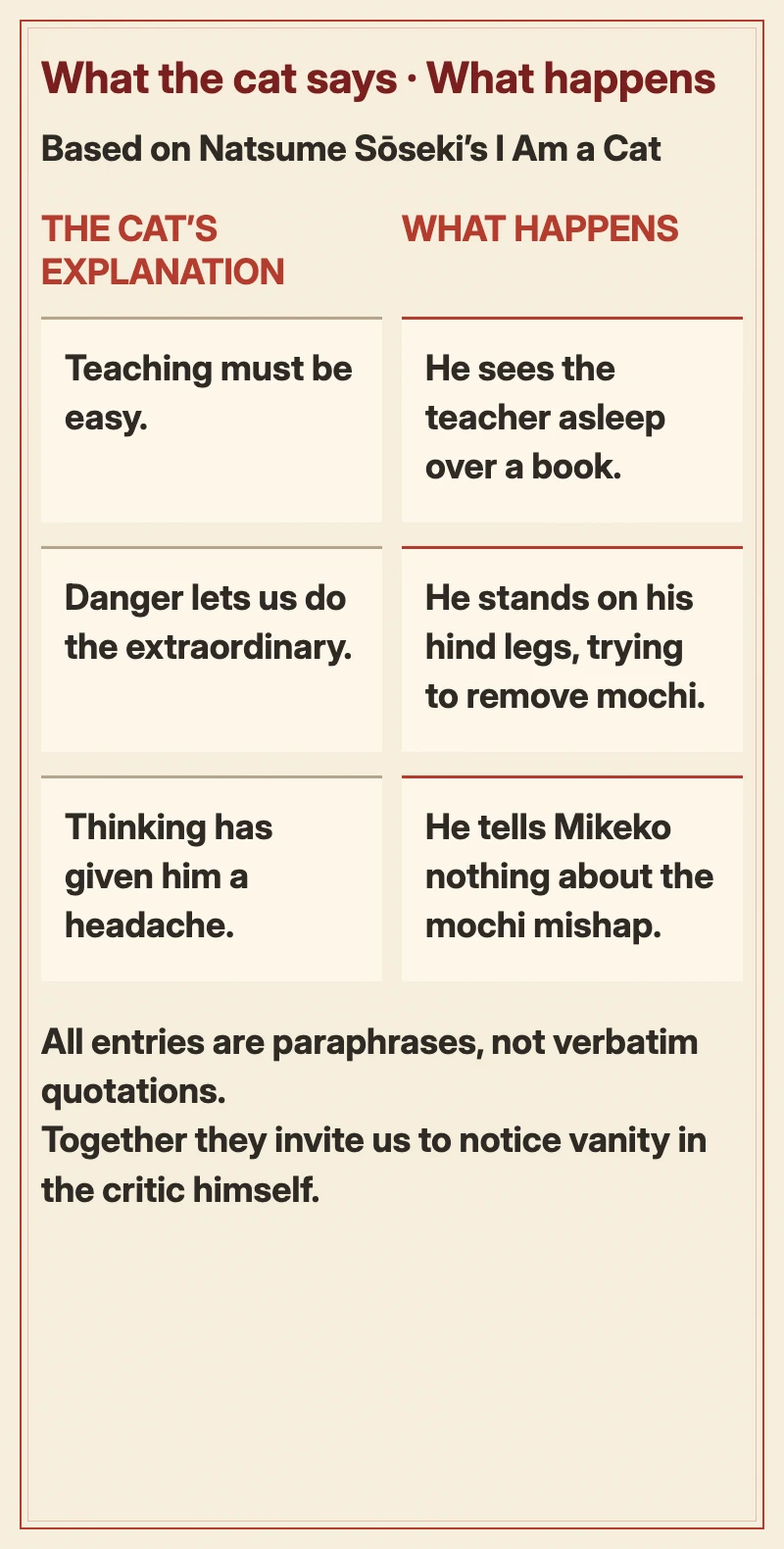
The mochi scene becomes less interesting if the cat is treated simply as a wise judge of foolish humans. His own predicament also receives a grand theory. The third “truth” amounts to this: danger can make us do what we ordinarily cannot. Standing on his hind legs becomes evidence for a magnificent discovery.
Yet the rice cake remains attached. Someone else must remove it. The explanation advances while the body stays in trouble. That contrast is the comic center of the episode, rather than a score proving either cats or humans more intelligent.
His explanation to Mikeko sharpens the point. “A headache from thinking” presents a much more dignified picture than the kitchen mishap. It is reasonable to read vanity in that choice. It is a further, unsupported step to say that every “truth” during the struggle was a calculated lie intended to deceive someone.
Compare the teacher earnestly sketching after Meitei’s impressive advice with the cat making an impressive theory out of failure. We can notice a family resemblance in their behavior without ranking them. This is one reading supported by the events, not a claim that Sōseki had only one purpose in writing the novel.
Frequently asked questions
What is the cat’s name?
At the beginning he says he has no name yet. Wagahai is a way of referring to oneself, not a proper name. Being addressed as “teacher” in a particular exchange should not be confused with receiving a formal name.
Is there one major case or adventure?
The novel accumulates incidents and conversations through the cat’s observations. Marriage discussions, a burglary, and the school quarrel matter, but they do not form a single case that the cat solves.
Does the cat die? Is it suicide?
He becomes drunk, falls into a water jar, attempts to escape, and eventually narrates his death. The text does not describe an intentional jump. The meaning of his final change of feeling is open to interpretation, as discussed above.
Does Kangetsu marry the Kaneda daughter?
He returns with a wife from his hometown. Sanpei is the man who says he has decided to marry the Kaneda daughter. The beer gathering celebrates Sanpei’s prospective marriage, not a wedding between Kangetsu and the daughter.
Is everything the cat says reliable?
His observations can be sharp without being infallible. Compare his judgment about the teacher’s naps, his theories during the mochi mishap, and his account to Mikeko. Medical or historical claims made in the conversations also remain part of the fiction rather than guaranteed modern knowledge.
Where to start reading
Begin with Chapter One to follow the cat’s arrival. Then try the long mochi passage in Chapter Two, beginning in Japanese with “今朝見た通りの餅が.” It is a good place to hear how his explanations continue while his dignity unravels.
- Read the complete Japanese text — Aozora Bunko
- About this Japanese text (bibliographic details)
- Read an early English translation — Chapters I–II only
Aozora Bunko is a free digital library of Japanese literature. Its bibliographic page identifies the text’s publication history and the edition used for digitization. The University of Nebraska–Lincoln / Zea Books edition is Kan-ichi Ando’s early English translation, first published in 1906. The university describes it as Chapters I and II only and makes it available as a public-domain work. It does not contain the complete novel or its ending. Our English guide covers the later chapters in our own words, using the complete Japanese text as its narrative source.
Plot statements and the short translated excerpts above come from that Japanese text. The brief author introduction is supported by the National Diet Library’s Sōseki profile. The explanation of Namu Amida Butsu follows the Honpa Hongwanji Mission of Hawaii’s service guide; the phrase’s meaning and daily use can also be checked in Ryuganji Temple’s official English explanation. These sources supply vocabulary, not a religious verdict on the cat’s ending. The word kurumaya, behind the explanation of Kuro’s household, can be checked in Shogakukan’s Japanese dictionary entry (in Japanese).
Illustrations were created from the text’s clues and are not reconstructions of an actual house or portraits of historical people. Images use AI generation and original program-drawn diagrams. Typefaces: Shippori Mincho, IBM Plex Sans JP, Inter, Source Serif 4, and M PLUS Rounded 1c, under the SIL Open Font License. Short quotations in this production are our translations, not copied from the historical English edition.
Sources
Where the facts and numbers in the video and on this page come from.
- Read the complete Japanese text — Aozora Bunkoaozora.gr.jp/cards/000148/files/789_14547.html
- About this Japanese text (bibliographic details)aozora.gr.jp/cards/000148/card789.html
- Read an early English translation — Chapters I–II onlydigitalcommons.unl.edu/zeabook/112
- opentracks.com
- National Diet Library’s Sōseki profilendl.go.jp/portrait/e/datas/307/index.html
- Honpa Hongwanji Mission of Hawaii’s service guidehongwanjihawaii.com/the-jodo-shinshu-service
- Ryuganji Temple’s official English explanationen.ryuganji.jp/service
- Shogakukan’s Japanese dictionary entrykotobank.jp/word/%E8%BB%8A%E5%B1%8B-486561
Voice, music, art
- Voices: synthetic narration with Irodori-TTS v4.1-Small (Japanese, MIT) / Kokoro-82M (English, Apache-2.0).
- Music (OpenTracks): "茶屋にて" by MATSU; "縁側" by siroimu; "百花繚乱" (artist not listed); "藁の記憶" (artist not listed).
- Fonts: Shippori Mincho, IBM Plex Sans JP, Source Serif 4, Inter, M PLUS Rounded 1c (SIL Open Font License).